

 See My Latest Article on HelloNation
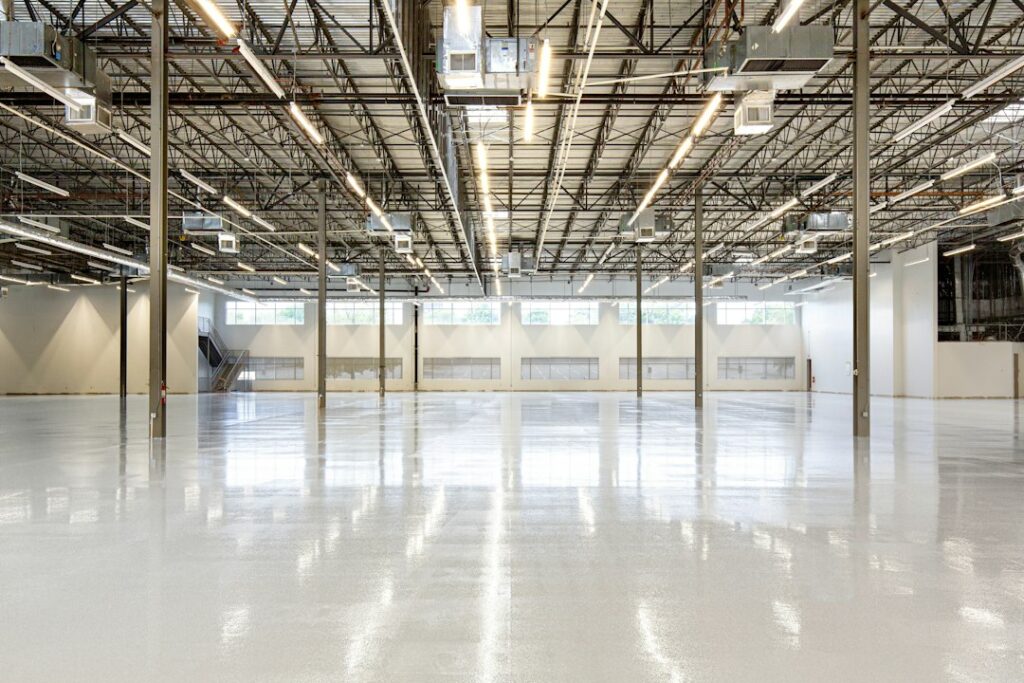
Industrial floor coatings are not interchangeable. The right system depends on the concrete’s condition, the work performed in the space, exposure to water or chemicals, traffic levels, cleaning practices, and the amount of downtime available for installation.
For facilities in Monroe County, seasonal moisture, winter conditions, tracked-in deicing materials, and temperature changes can also affect performance. A coating that works well in a dry storage room may be unsuitable for a vehicle area, food-processing space, workshop, or regularly washed production floor.
What should an industrial floor coating accomplish?
The primary purpose is to protect the concrete and create a safer, easier-to-maintain surface. A properly selected system may provide:
- Resistance to abrasion from carts, forklifts, pallet jacks, and foot traffic
- Protection from oils, fuels, cleaners, acids, alkalis, and other chemicals
- Reduced dusting from worn concrete
- Improved resistance to water penetration and staining
- Better visibility through color or markings
- A surface that can be cleaned more consistently
- Added slip resistance when the floor is wet or exposed to spills
A coating is not a substitute for repairing structural problems. Cracks caused by movement, settlement, moisture pressure, or damaged joints may continue to affect the finished surface unless the underlying issue is addressed.
Which coating types are commonly used?
Several resin systems are used for industrial and commercial concrete floors. Each has different strengths.
Epoxy
Epoxy is widely used because it bonds well to properly prepared concrete and forms a hard, dense surface. It is often considered for warehouses, workshops, utility rooms, manufacturing spaces, and areas with moderate to heavy traffic.
Its limitations include sensitivity to moisture during installation and possible yellowing or chalking when exposed to strong sunlight. Epoxy can also become slippery when smooth and wet unless an aggregate is added to the surface.
Polyurethane
Polyurethane, sometimes called urethane, is valued for flexibility, abrasion resistance, and resistance to ultraviolet exposure. It is often used as a topcoat over another resin system rather than as the only layer.
Some polyurethane formulations are better suited to temperature changes, impact, or chemical exposure than standard epoxy. However, application requires attention to mixing, recoat timing, humidity, and surface conditions.
Polyaspartic systems
Polyaspartic coatings can cure relatively quickly, which may reduce the time a floor is unavailable. They are often selected where fast return to service is a priority.
Fast curing can also make installation less forgiving. Temperature, humidity, application speed, and the condition of the concrete must be controlled carefully. A rapid cure does not eliminate the need for proper surface preparation.
Methyl methacrylate
Methyl methacrylate systems can cure at low temperatures and may be useful where cold conditions or short shutdown windows create challenges. They are found in some specialized industrial, commercial, and institutional settings.
These products may have strong odors during installation and require careful ventilation, access control, and fire-safety planning. Their suitability depends heavily on the facility and the specific exposure conditions.
Cementitious urethane
Cementitious urethane is designed for demanding environments involving frequent washdowns, heat, moisture, thermal shock, and chemical exposure. It may be considered for food-related operations, commercial kitchens, processing rooms, and other wet industrial areas.
This system is usually more substantial than a basic decorative coating. The existing concrete, floor drains, expansion joints, and cleaning methods all influence the design.
How does the work environment determine the choice?
The floor should be evaluated according to what actually happens on it, not simply how the room looks.
Ask these practical questions:
- Are forklifts or heavy carts used?
- Are metal wheels, dropped tools, or pallets likely to impact the surface?
- Will standing water or routine washdowns occur?
- Are oils, solvents, acids, salts, or alkaline cleaners present?
- Does the floor experience hot equipment, steam, or thermal shock?
- Is sunlight entering through doors, windows, or skylights?
- Must the area remain operational during most of the work?
- Do workers need a high-traction surface?
Chemical resistance is specific to the product and the chemical. A floor that resists motor oil may not resist concentrated acids, solvents, disinfectants, or repeated exposure to aggressive cleaners. Product data should be reviewed for the actual substances, concentration, temperature, and length of contact expected.
Why is surface preparation so important?
Most coating failures are related to the condition or preparation of the concrete rather than the coating category alone.
The surface generally needs to be clean, sound, and adequately profiled so the coating can bond mechanically. Preparation may include mechanical grinding, shot blasting, removal of oils, crack treatment, and repair of weak or damaged concrete.
Concrete that appears dry may still contain moisture vapor moving upward from below. Excess moisture can cause blistering, debonding, discoloration, or other failures. Moisture testing is especially relevant for slabs at or below grade, older floors, and areas with a history of dampness.

Existing paint, curing compounds, sealers, grease, and embedded contaminants can also prevent adhesion. Applying a new coating over a glossy or contaminated surface may produce a short-lived result even when the coating itself is well formulated.
How should winter conditions in Monroe County affect planning?
Cold weather, snow, freezing rain, and deicing materials create several floor-related concerns. Vehicles and pedestrians can track water, salt, grit, and melting snow into entrance areas. These contaminants can increase wear and create slip hazards.
Concrete and coating materials also respond to temperature and humidity. A floor may be too cold for a particular product to cure correctly, even when the air temperature seems acceptable. Doors opening frequently during winter can introduce moisture and temperature changes that affect installation.
For heavily used entrances, loading areas, and maintenance spaces, useful design considerations may include:
- A slip-resistant texture that can still be cleaned effectively
- Proper drainage and attention to low spots
- Chemical resistance to salts, cleaners, and automotive fluids
- Durable transitions at doors and ramps
- A maintenance plan for removing abrasive grit before it wears the surface
Slip resistance should be balanced carefully. A very rough texture may improve traction but can make cleaning more difficult and may wear down wheels or footwear.
Is a thicker coating always better?
No. Thickness alone does not determine performance.
A thin coating may be appropriate for a lightly used utility room with limited exposure. A multi-layer system may be needed for heavy traffic, chemical contact, impact, or frequent washdowns. However, a thick system installed over weak, damp, or poorly prepared concrete can still fail.
The design should match the service conditions. Excess material may add cost and installation time without solving the actual problem, while an underspecified system may wear prematurely.
What maintenance does a coated floor require?
Industrial coatings are durable but not maintenance-free. Routine care should include prompt removal of spills, regular sweeping or dust removal, and cleaning with products compatible with the coating.
Avoid assuming that stronger chemicals clean better. Highly aggressive cleaners, abrasive pads, standing water, and neglected cracks or joints can shorten the useful life of the floor.
A practical maintenance plan identifies:
- Approved cleaning chemicals and dilution levels
- Suitable brushes, pads, or floor machines
- Spill-response procedures
- Areas where traction may change when wet
- Inspection intervals for cracks, joints, chips, and worn paths
- Conditions that require temporary protection or repair
What is the most reliable way to compare options?
Compare complete floor systems rather than isolated product names. The evaluation should include the primer, body coat, broadcast aggregate if used, topcoat, thickness, surface preparation, curing conditions, expected service life, repair method, and cleaning requirements.
The most suitable choice is usually the system that matches the facility’s actual risks and operating schedule—not necessarily the hardest, thickest, fastest-curing, or least expensive option.